Flooring and indoor air quality: what to know about VOCs and off-gassing
By Dana Whitfield · Updated 2026-08-26
This is general information, not medical advice. If you or someone in your household has respiratory sensitivities or chemical sensitivity concerns, talk to a doctor about specific precautions before a flooring installation.
New flooring often comes with a noticeable smell for the first days or weeks after installation. That’s usually volatile organic compounds, VOCs, releasing from adhesives, finishes, or the material itself as it cures. For most people this is a temporary nuisance. For anyone with respiratory sensitivities, it’s worth understanding before, not after, the installation happens.
Where VOCs actually come from in a flooring job
- Adhesives. Solvent-based adhesives used to glue down vinyl, some engineered wood, or carpet backing are a common source.
- Finishes. Site-applied hardwood finishes, particularly oil-based polyurethane, tend to off-gas more noticeably than prefinished materials or water-based alternatives.
- The material itself. Certain vinyl and synthetic products can emit VOCs as part of their manufacturing chemistry, independent of how they’re installed.
Prefinished materials, where the finish was cured at the factory rather than applied on-site, generally produce less noticeable off-gassing in your home, since the strongest curing period already happened before delivery.
Lower-VOC choices, if this matters to you
| Choice | Why it helps |
|---|---|
| Water-based finishes over oil-based | Lower VOC content and typically a milder smell |
| Prefinished flooring over site-finished | Curing happens at the factory, not in your home |
| Low-VOC or water-based adhesives | Available for most material types, ask specifically |
| Solid hardwood or tile over some synthetics | Generally lower inherent off-gassing, though finish and adhesive still matter |
Practical steps during and after installation
- Ask before the job, not after. Request low-VOC finish and adhesive options if this is a priority; not every contractor defaults to them unless asked.
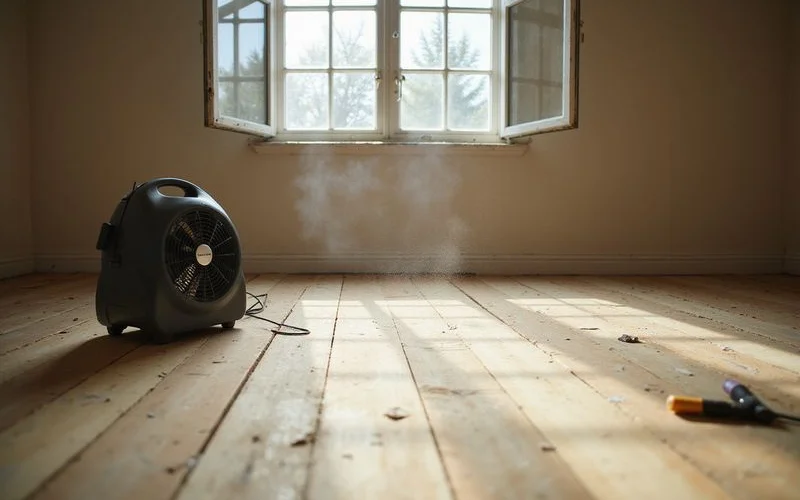
- Ventilate. Open windows and run fans for at least several days after installation, longer for stronger odors.
- Consider timing. If someone in the household is particularly sensitive, staying elsewhere for the first few days can help, especially after on-site refinishing.
- Watch for symptoms. Headaches, eye or throat irritation, or breathing difficulty that seem tied to the new flooring smell are worth mentioning to a doctor, particularly if they persist beyond the first couple of weeks.
How long off-gassing actually lasts
The strongest off-gassing period is typically the first few days after installation, tapering noticeably within the first couple of weeks. Site-applied finishes, particularly oil-based polyurethane used in hardwood refinishing, tend to have a longer and more noticeable curing period than prefinished materials. If you’re planning a whole-house project, staggering the work by section rather than doing every room at once can reduce how concentrated the smell gets at any one time, which matters most for anyone especially sensitive to it.
Certifications worth asking about
Some flooring products carry third-party low-emission certifications that test for VOC content against a defined standard, rather than relying on a manufacturer’s own “low-VOC” label alone. If indoor air quality is a significant priority, ask your contractor or retailer whether the specific product you’re considering carries an independent certification, and ask to see the documentation rather than taking a marketing claim at face value.
Putting it in perspective
For most households, the smell from new flooring is a short-term inconvenience that resolves with normal ventilation. It becomes a bigger consideration for homes with infants, anyone with asthma or chemical sensitivities, or during a whole-house project where multiple rooms are off-gassing at once. Asking about finish and adhesive options up front costs nothing and gives you more control over the outcome.
Air purifiers and filtration during the curing period
Running a portable air purifier with an activated carbon filter, which is more effective at capturing VOCs than a standard particle filter alone, can meaningfully reduce indoor concentration during the first days after installation. This is a reasonable extra step for a household with young children, anyone pregnant, or someone managing a respiratory condition, on top of the basic ventilation steps that work for most situations.
Compare flooring contractors and see how they’re rated on our scoring methodology, or return to the homepage to browse by project type.
Common questions
- What does off-gassing mean?
- Off-gassing is the release of volatile organic compounds (VOCs) from materials like adhesives, finishes, and some synthetic flooring products as they cure. It's usually strongest in the first days to weeks after installation and tapers off over time.
- Which flooring types tend to have higher VOC concerns?
- Certain vinyl products, some adhesives, and solvent-based finishes used in on-site hardwood refinishing are commonly cited as higher-VOC sources. Low-VOC and water-based finish options exist and reduce this significantly.
- Is new flooring smell dangerous?
- A noticeable smell after installation is common and usually fades within days to a couple of weeks with good ventilation. If you have respiratory sensitivities or the smell is unusually strong or long-lasting, it's worth discussing with the installer and, if needed, a doctor.
- How can I reduce VOC exposure after installation?
- Ventilate the space well for the first several days, ask for low-VOC adhesives and finishes up front, and consider timing sensitive household members' time away from the space during the initial curing period.