Commercial flooring for Connecticut businesses: what to consider before you choose
By Dana Whitfield · Updated 2026-09-04
Flooring for a retail space, office, or restaurant faces a different set of demands than a home. Foot traffic is constant, downtime costs money, and there are often code requirements a residential job never has to think about. Getting these decisions right upfront avoids a redo that costs far more than getting a quote wrong the first time.
What changes for commercial spaces
- Traffic rating. Commercial-grade materials are built and rated for continuous heavy use, not occasional residential foot traffic. A residential-grade product in a busy retail space wears out fast.
- Slip resistance and code compliance. Many commercial spaces, especially those open to the public, have specific requirements around slip resistance and accessibility that a residential job doesn’t need to address.
- Downtime. Every day a space is closed or partially usable during installation is potential lost revenue, which changes how installation gets scheduled.
- Maintenance load. High-traffic commercial floors need a maintenance plan, not just a one-time install, to hold up over years of continuous use.
Common commercial flooring choices
| Material | Typical use case | Why it’s chosen |
|---|---|---|
| Commercial-grade vinyl | Retail, offices, healthcare | Durable, relatively low-cost, easy to maintain |
| Polished or coated concrete | Warehouses, industrial, some retail | Extremely durable, low long-term maintenance |
| Commercial carpet tile | Offices | Easy to replace individual damaged sections |
| Porcelain tile | Restaurants, retail entries | Durable and resistant to spills and heavy wear |
Scheduling around business hours
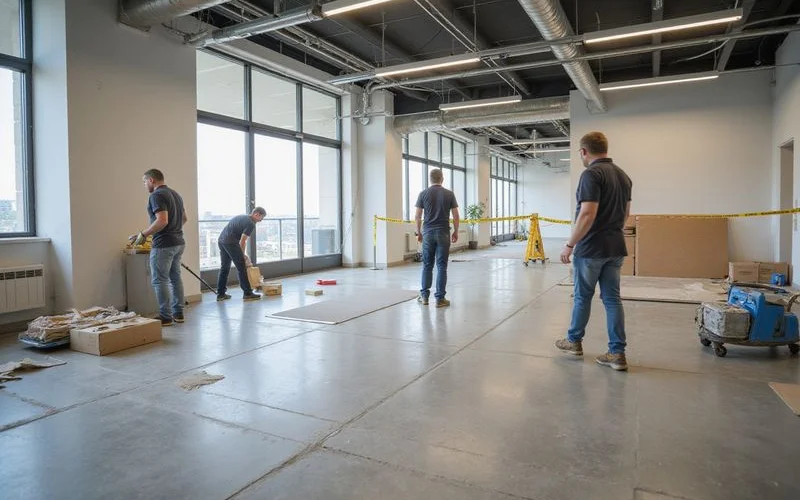
A full closure isn’t always necessary. Many contractors offer phased installation, working section by section so part of the space stays open, or overnight and off-hours work that lets the business run normally during the day. This typically costs more than a straightforward continuous install, so it’s worth weighing the added cost against the cost of lost business during a closure.
Questions to ask a commercial flooring contractor
- Have they done work in your specific type of space before (retail, restaurant, office, healthcare)?
- What traffic rating do they recommend for your expected foot traffic level?
- Can they work in phases or off-hours, and what does that add to the timeline and cost?
- Do they understand the code and accessibility requirements that apply to your space?
Not every residential flooring contractor takes on commercial work, and not every commercial contractor is equally comfortable with every material, so ask directly about relevant experience rather than assuming general flooring experience transfers.
Budgeting for a maintenance plan, not just installation
A commercial floor’s lifespan depends heavily on how it’s maintained after installation, not just what was installed. Ask the contractor what maintenance schedule they recommend for the specific material and traffic level, and whether they offer or can refer maintenance services. Polished concrete, for example, typically needs periodic re-polishing or sealing to keep its finish and slip resistance, while commercial vinyl needs the right cleaning products to avoid damaging the wear layer. Building this into your budget from the start avoids a surprise a few years in when the floor looks worn faster than expected.
Planning around a lease or ownership timeline
If you’re leasing the space, check what your lease says about improvements and who’s responsible for flooring by the time you move out. Some commercial leases require restoring the space to its original condition, which affects whether a major flooring investment makes financial sense for a shorter-term lease. Owned commercial space removes that constraint and generally makes a higher-durability, longer-lifespan material a better long-term value. The same restoration logic applies, on a smaller scale, to a residential tenant deciding what to install; our guide to flooring options for renters covers that version of the tradeoff.
Getting multiple quotes for a commercial job
Commercial quotes can vary more than residential ones because scope, material grade, and scheduling flexibility all move the price independently. Get at least two or three quotes that specify the exact material, traffic rating, and installation timeline so you’re comparing equivalent scopes rather than just comparing bottom-line numbers.
Insurance and liability during the project
Commercial spaces open to customers or employees during a phased installation carry more liability exposure than an empty residential room does. Confirm the contractor carries adequate general liability insurance for a space that stays partially operational, and ask how they cordon off active work areas to keep customers and staff away from tools, adhesives, and uncured coatings. A contractor experienced with commercial work should have a clear answer here without needing to be prompted.
Compare businesses that handle commercial projects under our commercial flooring category, scored using our rating methodology, or start from the homepage to browse other project types.
Common questions
- How is commercial flooring different from residential flooring?
- Commercial spaces need materials rated for much higher foot traffic, often have code requirements around slip resistance and ADA compliance, and usually require installation scheduled around business hours to limit downtime.
- What flooring holds up best in high-traffic commercial spaces?
- Commercial-grade vinyl, polished or coated concrete, and certain tile products are common choices because they're rated for heavier wear than residential-grade materials and hold up better under constant use.
- Can flooring be installed without closing the business?
- Often yes, with phased installation done in sections, overnight work, or during off-hours. It costs more than a single continuous install but avoids a full closure, which matters for businesses that can't afford lost days.
- Do commercial flooring projects need permits?
- More often than residential replacement, especially if the work is part of a larger renovation or involves accessibility requirements. Check with your local building department and factor permit timelines into your project schedule.