Who's liable when a flooring installation goes wrong
By Dana Whitfield · Updated 2026-08-21
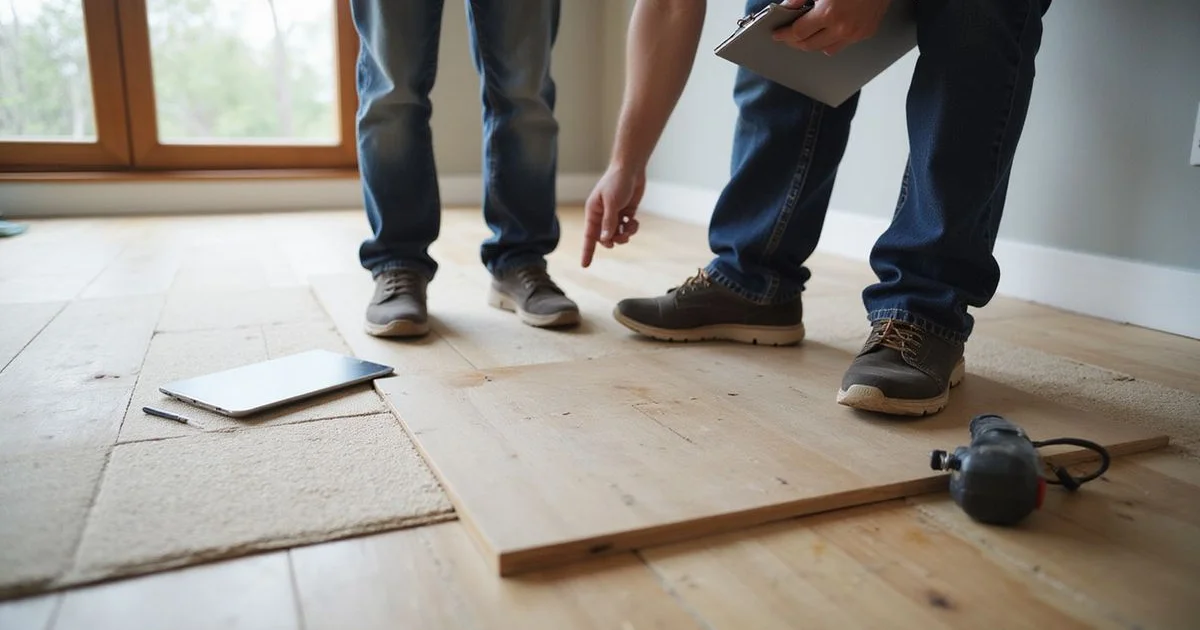
This is general information, not legal advice. If you’re dealing with a specific dispute, a licensed attorney can advise on your particular situation and any deadlines that apply.
When a floor fails, whether it’s cupping hardwood, lifting vinyl, or cracked tile grout, the frustrating part is often figuring out who’s actually responsible before you can figure out what happens next. Responsibility usually lands in one of three places, and knowing which one applies changes what you do about it.
The three usual sources of responsibility
| Cause of failure | Who’s typically responsible |
|---|---|
| Manufacturing defect in the material | The manufacturer, under the product warranty |
| Installation error (bad prep, wrong adhesive, skipped moisture barrier) | The contractor, under a labor or workmanship warranty if offered |
| Homeowner-caused damage after installation | The homeowner, generally not covered by any warranty |
Some failures are genuinely ambiguous. Cupping in hardwood, for instance, can come from a moisture problem the contractor should have caught, a defect in the wood itself, or something in how the home is being used after installation, like humidity levels never checked or corrected. This is where an independent second opinion earns its cost.
Why documentation matters more than memory
If a dispute happens, what’s in writing matters far more than what someone remembers being said. Keep the original contract, any change orders, photos taken during and after installation, and the material and warranty documentation. A homeowner who can show “this is what was promised, this is what was installed, and this is when the problem appeared” is in a much stronger position than one relying on a verbal account of a conversation from months earlier.

What a reasonable resolution process looks like
- Raise it directly, in writing. Describe the problem specifically and ask for a response by a reasonable date.
- Request an inspection. A contractor should be willing to come look at the problem in person before disputing responsibility.
- Get a second opinion if needed. An independent inspector or another contractor can help determine the actual cause when the first contractor disputes fault.
- Escalate if there’s no resolution. Connecticut’s Department of Consumer Protection handles complaints against registered home improvement contractors, and this is generally the next step before legal action.
Reducing the risk before it happens
Complaint patterns across contractor reviews point to a few recurring issues: unclear documentation, slow responses to problems, and disputes over what was actually included in the original scope. A contract with a specific scope of work, a stated labor warranty, and a clear point of contact for problems doesn’t prevent every issue, but it removes most of the ambiguity that turns a fixable problem into a drawn-out dispute.
For what Connecticut law requires in a home improvement contract, see our guide to flooring contractor laws in the state.
When a subcontractor is involved
Many flooring companies subcontract part or all of the physical installation, even when you signed a contract with the main business. Responsibility for installation error generally still sits with the company you contracted with, not the subcontractor directly, but this can get murky if the main business tries to point to the subcontractor as a separate, unaccountable party. Ask upfront whether the crew doing the work is direct employees or subcontracted, and confirm the company you’re contracting with is the one standing behind the labor warranty regardless of who physically installs it.
What an independent inspection typically involves
An independent flooring inspector examines the failed area, checks moisture levels, reviews installation methods where visible, and often researches the specific product’s known failure patterns before issuing a written opinion on likely cause. This costs money out of pocket, but a written, professional opinion carries far more weight in a dispute than two parties each insisting the other is at fault. It’s most worth the cost for expensive hardwood or large-scope jobs where the disputed amount justifies the inspection fee.
Small claims court as a last resort
For disputes that don’t resolve through direct communication or a state complaint, small claims court is often a realistic option for homeowners, since it doesn’t require an attorney and has a lower filing cost than a full civil suit. Connecticut’s small claims process has a dollar limit on what it can award, so check whether your dispute falls within that range before pursuing this route, and bring your full documentation, contract, photos, and written correspondence, to support your case.
Compare contractors and see how ratings are built on our scoring methodology, or return to the homepage to browse by category.
Common questions
- Is the contractor always responsible if flooring fails?
- Not always. If the failure traces back to a manufacturing defect, that's typically the manufacturer's responsibility. If it traces back to how the floor was installed, that's usually the contractor's. A clear contract and documentation help determine which applies.
- What if I don't know why the floor failed?
- This is common, and it's why getting a second opinion from an independent inspector or another contractor matters before assigning blame. Cupping, gapping, or delamination each point toward different likely causes.
- Does homeowners insurance cover a failed flooring installation?
- Generally no, if the failure is due to installation error or a defective product; that's a contractor or manufacturer issue, not a covered loss. Insurance is more relevant for sudden events like a burst pipe that damages flooring, not workmanship problems.
- What if the contractor won't respond to a complaint?
- Document everything in writing, including photos and dates. Connecticut's Department of Consumer Protection accepts complaints against registered home improvement contractors, which is typically the next step if direct communication stalls.